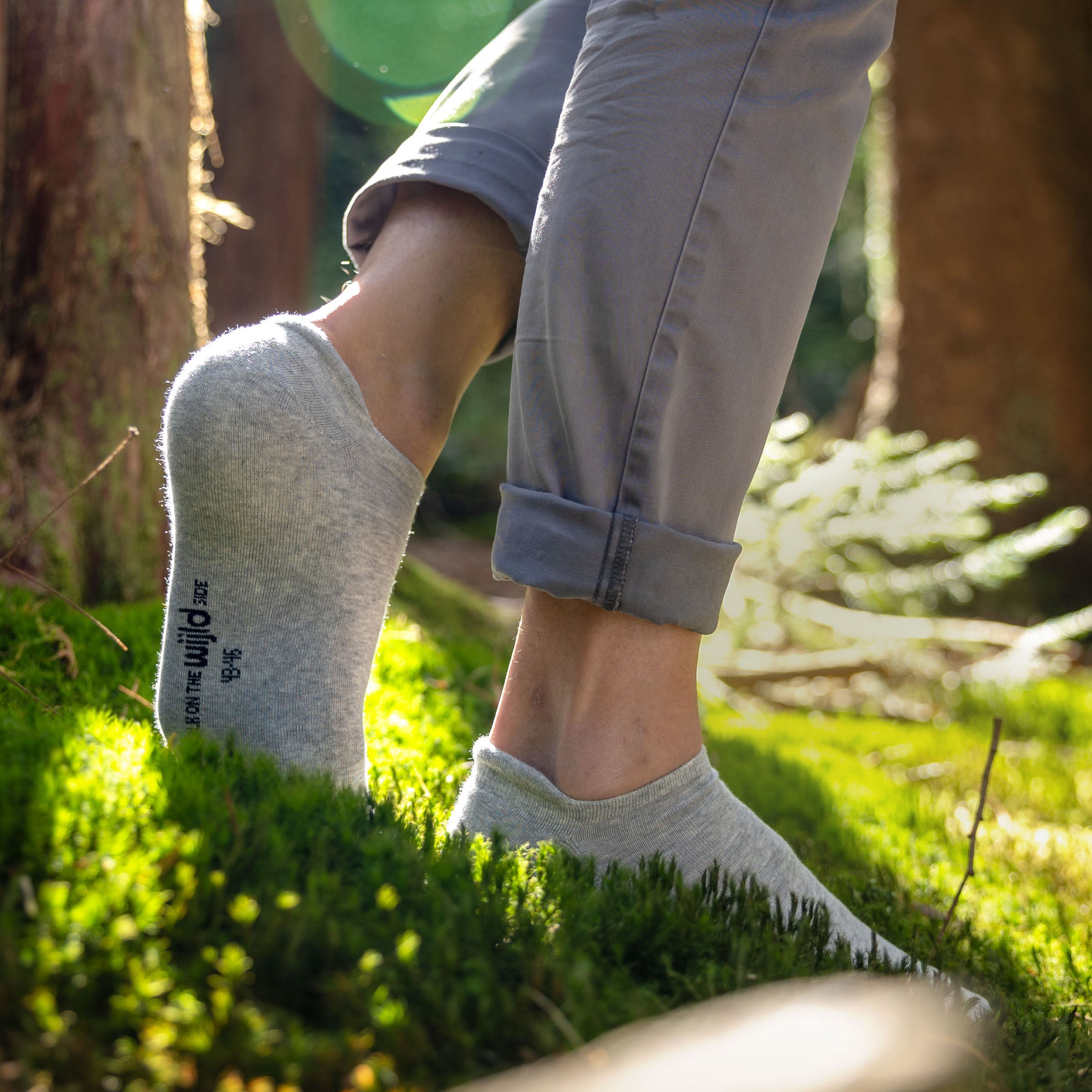


Even though "clothing made from wood" might sound strange and scratchy at first, our WoodShirts, tank tops, long sleeves, boxer shorts, socks, and hoodies are actually made from a super soft fabric. In addition to many ecological benefits, it also offers unique qualities and optimal comfort. In short: we create woody clothing with a feel-good factor. We’re happy to explain in more detail what makes these unique qualities special and why fashion made from wood feels so good to wear.




WHY FASHION MADE FROM WOOD IS SO SILKY SOFT
Our skin reacts differently depending on the skin type to the environment. Besides external environmental factors, such as the sun, our skin can also naturally react to textiles. Many people complain about sensitivities to various textiles because their rough surface causes itching and irritation. Especially for people with neurodermatitis, there are often problems with the skin compatibility of certain fibers.

Smooth fiber structure ensures optimal wearing comfort
The wood fibers in our clothing have an especially skin-friendly and smooth surface that flatters the skin instead of irritating it. This results in less friction on the skin, which is why our wood-based clothing feels like a second skin. In a study conducted by the University Hospital Heidelberg, over 80% of participants reported that wearing wood fibers significantly improved their skin condition, and both the skin-sensory and thermoregulatory properties were convincing.

Comparison of fibers from cotton, wool, and wood under the electron microscope.
FABRIC MADE FROM WOOD – THERMOREGULATING AND BREATHABLE
Why we find fabrics comfortable depends not only on their feel but also on the skin climate. The extent to which fabrics regulate temperature has a major impact on how comfortable we feel. In summer or during physical exertion, our body temperature rises, as does sweat production. The evaporation of sweat on the skin’s surface cools the body. During intense activity, a person can lose up to 1.8 liters per hour this way. The requirement for close-to-the-body textiles is therefore to ensure fast and even moisture transport to support the body’s natural cooling effect. The key factors are thus a high water absorption capacity and a high wicking speed.
In fact, the fiber made from wood – as we use it for our sustainable clothing – has a significantly higher water capacity and absorption rate than cotton or polyester. The maximum absorption capacity within 20 seconds for wood fibers is an impressive 380%, while for cotton and polyester it is only about 16 to 19%. The special nanostructure of the wood fibers ensures that moisture is quickly transported and absorbed inside the fiber. This officially contributes to thermoregulation by enabling optimal evaporation on the fabric surface through a homogeneous distribution of liquid. The drying behavior of wood fiber can also easily compete with that of conventional fibers. Although many people believe that polyester fabrics dry faster than others, there is no difference in drying kinetics between polyester and wood fibers when the same amount of moisture in the textile is assumed. Additionally, it should be mentioned that polyester fibers are closed and therefore cannot absorb moisture, so the moisture remains only on the surface.

Cools in summer, warms in winter
The fibers made from wood have very special thermophysiological properties. As a result, our clothing provides excellent thermal insulation in cold conditions. At the same time, when it’s warm or during physical activity, sweat is drawn away from the body and released into the environment to optimally support body cooling.
WHY ARE WOODSHIRTS ODOR-RESISTANT?
Our skin hosts numerous microorganisms that are important for our skin flora. When we sweat, the microorganisms can multiply due to the moisture, start to work, and this causes the sweat odor. Through skin contact and sweat, the bacteria naturally also get into the fabric. Sometimes it is extremely difficult to remove these odors from textiles, especially with sportswear made from polyester fabrics, where these problems are well known.

Stays fresher longer by reducing odor formation
The fabric of our clothing made from wood stays fresh longer because it inhibits bacterial growth. When comparing synthetic materials, cotton, and our wood fiber, it becomes clear that synthetic materials exhibit bacterial growth that is 100 to 1,000 times stronger, and on cotton, the growth is still about 10 times higher than on our wood-based fabric. The reason for this is that with other fibers, water remains on the fiber surface, where it is fully accessible to bacteria. In contrast, the wood fiber almost completely absorbs the water into the fiber, depriving bacteria of their breeding ground. Additionally, bacteria adhere less easily to the smooth fiber surface than to synthetic fibers or cotton.
Because the wood fiber can better wick away moisture, bacteria are deprived of the necessary nutrients, and bacterial growth is inhibited. Due to this special antibacterial property of the wood fiber, our clothing made from wood stays fresh longer, and you can, for example, wear our WoodShirts longer without having to deal with unpleasant odors.