
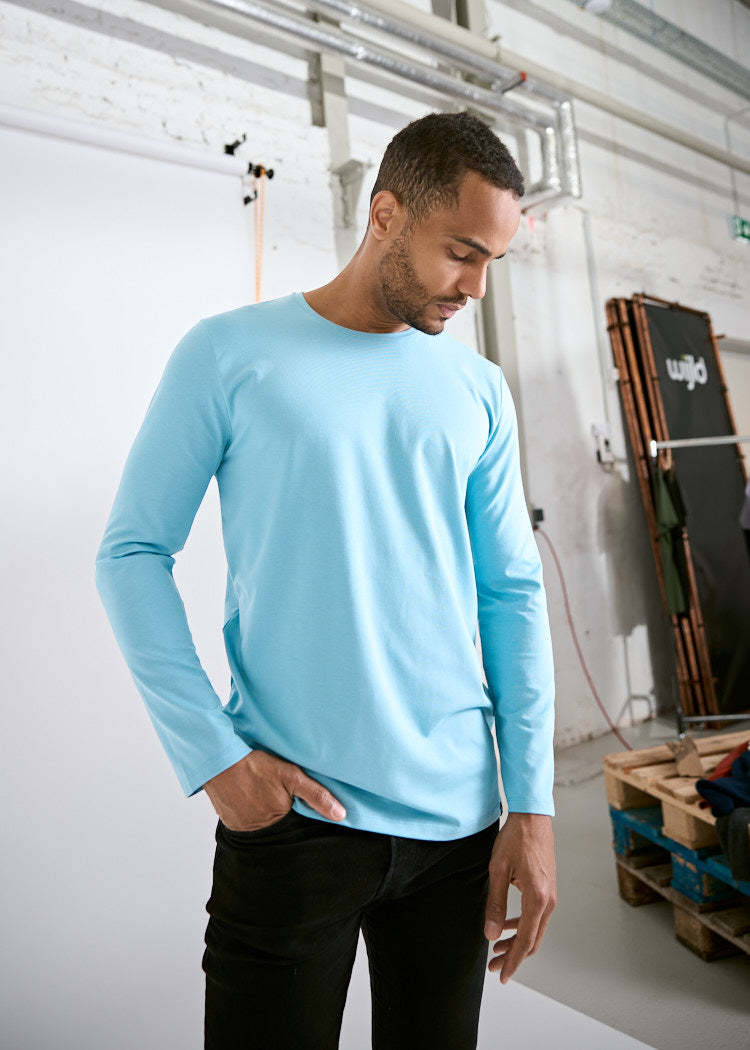
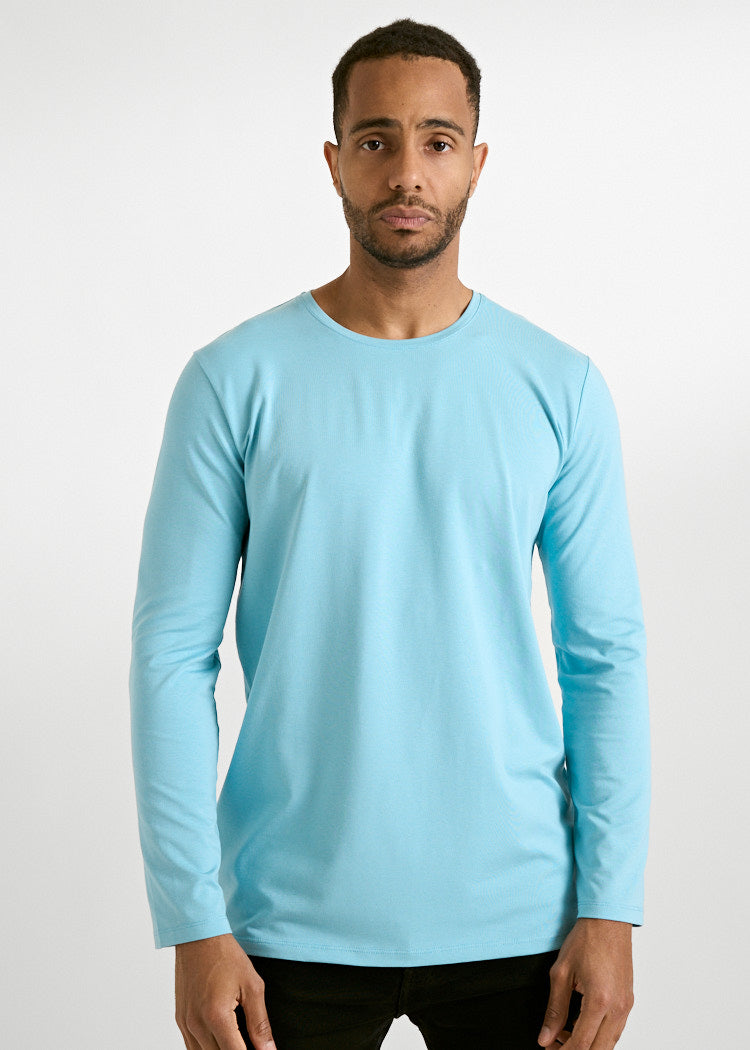
MEN'S LONG-SLEEVE SHIRT DAVID MILKY BLUE
incl. VAT. plus shipping

| International | S | M | L | XL | 2XL | 3XL |
| Europe | 46 | 48 | 50 | 52 | 54 | 56 |
| USA | 36 | 38 | 40 | 42 | 44 | 46 |
| UK | 36 | 38 | 40 | 42 | 44 | 46 |
| Length |
71 cm 28.0 Inch |
73 cm 28.7 Inch |
75 cm 29.5 Inch |
77 cm 30.3 Inch |
79 cm 31.1 Inch |
81 cm 31.95 Inch |
| Chest |
46 cm 18.1 Inch |
50 cm 19.7 Inch |
54 cm 21.3 Inch |
58 cm 22.8 Inch |
62 cm 24.4 Inch |
66 cm 26.0 Inch |
| Sleeve |
62 cm 24.4 Inch |
63 cm 24.8 Inch |
64 cm 25.2 Inch |
64 cm 25.2 Inch |
66 cm 26.0 Inch |
67 cm 26.4 Inch |
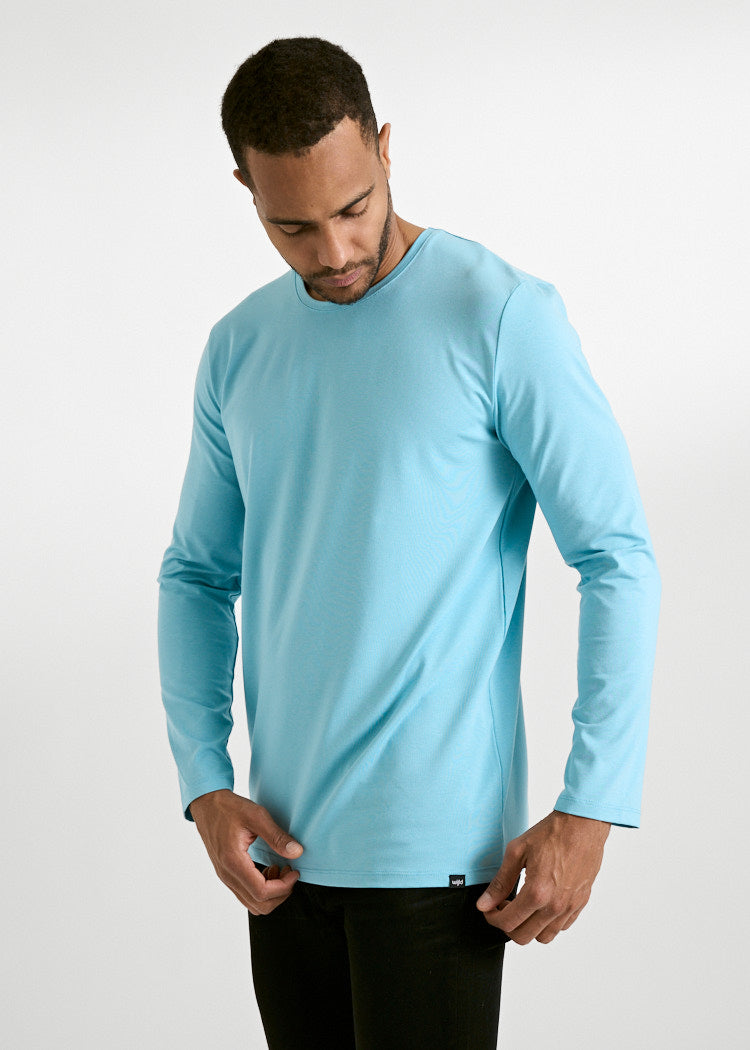
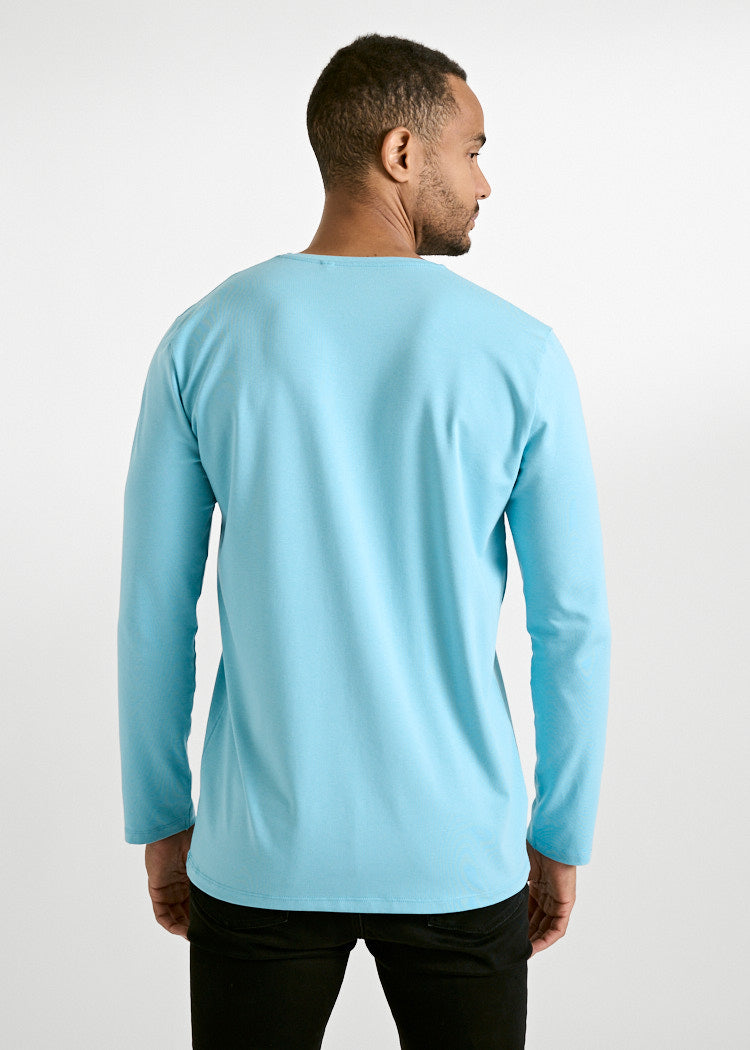
Our David Milky Blue long-sleeve shirt is the perfect close-fitting shirt for men, made from wood-derived fibers and featuring a crew neck: sustainable, fairly made, and it feels like a second skin!
- Comfortably soft and breathable fabric for maximum comfort
- 62% Lyocell (from sustainable forestry), 31% organic cotton & 7% elastane
- with a fabric weight of 230 g/m²
- Close-fitting cut and crew neck
- Maximum shrinkage rate of 5%: Therefore, if you are between two sizes, we recommend choosing the larger one
The model is 1.84 m tall and wears size L
CARE
With the right care, you can wear your new favorite pieces for a long time while conserving resources and protecting your clothes. And the best part? You don’t have to wash them nearly as often as you might think!
This is especially true of clothing made from wood fibers, but also of wool: Both materials have antibacterial properties and quickly release moisture back into the air. This deprives bacteria of the conditions they need to grow, prevents odors, and keeps your clothes fresh for longer. Washing less often not only means less effort, but also extends the life of your clothes—this applies to all the other materials in your wardrobe too!
First things first: Our garments containing wool need to be cared for differently than, for example, our WoodShirts.
When it comes to clothing made from recycled wool, the rule is: air it out instead of washing it! Wool largely cleans itself by neutralizing odors and absorbing and releasing moisture. If you do need to wash your wool garments, we recommend washing them by hand and at a low temperature to protect the fibers.
The right care for a long life
Even though our clothes stay fresh for longer, they eventually need to go in the washing machine. To help you enjoy your sweaters and shirts for as long as possible, we recommend these environmentally friendly care tips:
- Wash at 30 degrees
Gentle temperatures are completely sufficient to get your clothes clean. This not only protects the fibers, but also saves energy. - Use a low spin cycle
Low spin speeds protect delicate fibers and reduce wear and tear. - No fabric softener or tumble dryer
Wood fibers, organic cotton, and recycled cotton do not need fabric softener. They are naturally soft and comfortable to wear. And because our materials release moisture back into the air quickly, your clothes will also air-dry in a short time—so you can skip the dryer. Dryers also unfortunately shorten the lifespan of your favorite pieces.
SHIPPING & RETURNS
We ship your order within Germany with DHL GoGreen service. We also deliver to many other countries. You can find out which countries they are, exactly how shipping costs are calculated, and the order value above which they are waived here.
Does an item not fit, or do you not like the color? No problem at all—our returns portal is available for situations like these. Here you can find out how to send an item back to us and which conditions you need to observe.
MATERIAL & PRODUCTION
What makes our clothing so special is, on the one hand, the unique feel and the unique properties of wood fibers and, on the other hand, our environmentally friendly production. But in addition to wood, we also use other sustainable fibers for our favorite pieces.
Here is an overview:
Wood fibers
1. Production
By using wood, we rely on a raw material that is also native to our region, avoiding long transport routes. The wood used for our environmentally friendly clothing also comes exclusively from sustainable forestry. Compared with cotton, using wood is more ecological in many respects:
- Neither additional fertilizers nor large amounts of water for irrigation are needed: for example, we save 1,000 liters of water with just one WoodShirt
- 3–4 times less agricultural land is needed to achieve the same fiber yield as cotton
- During the production of our wood fiber, CO₂ emissions can be reduced twentyfold
- Fiber production takes place in a closed-loop process that uses an organic solvent, which is recycled again and again.
You can read more about the benefits of our wood fiber production here.
2. Functions
Wood fibers, in our case almost exclusively Lyocell, not only feel great against the skin, they also have many positive properties:
- Because they absorb moisture quickly, wood fibers help regulate temperature. They cool in summer and keep you warm in winter
- As wood fibers wick away moisture more effectively, they inhibit bacterial growth and give clothing made from wood antibacterial properties. This helps it stay fresh for longer
- The smooth fiber structure of wood fibers provides a silky-soft feel, creating less friction on the skin and helping to prevent itching and irritation
Organic cotton
In our wood-based clothing, we usually use a small proportion of organic cotton to provide women and men with perfect comfort. Wood fiber alone produces a fabric that is far too silky and, without the right structure, drapes very fluidly, making it unsuitable for most men. By using organic cotton, however, we can give our wood-based clothing more stability and ensure an optimal feel.
It is very important to us that only cotton from certified organic cultivation is used. This allows us to avoid chemical pesticides and fertilizers. In addition, organic cotton requires less water to produce than conventional cotton.
Among other sources, we have used organic cotton from Greece, India, and Tanzania. In general, however, we always make sure to choose the shortest possible routes, while knowing that cotton does not grow in our climate zone.
Recycled cotton
Another component of our sustainable collections is the use of recycled cotton. Instead of consuming new resources, we use fibers from old textiles and production scraps to create high-quality fabric for our garments. However, we only use recycled cotton in a blend. So why don't we use 100% recycled cotton? During the recycling process, cotton fibers become shorter, which can affect their durability and strength. To compensate for this while ensuring high quality, we combine recycled cotton with cotton, among other fibers. This allows us to create a long-lasting favorite piece for you that helps prevent waste and conserve resources.
Recycled polyester
We mainly use recycled polyester in our performance and sports shirts. Recycled polyester is made from old plastic bottles and other plastic waste, which is processed into new, high-performance fibers. These closed fibers cannot absorb moisture. In sports shirts, they ensure on the inside that moisture is quickly transported away from the body and can be absorbed and released again by the wood fiber on the outside. The result is a performance fabric that is breathable, temperature-regulating, and environmentally friendly at the same time. Using recycled materials also helps protect the environment, as producing recycled polyester requires significantly less energy than producing new polyester.
Recycled wool
We use recycled wool in some of our favorite pieces. Instead of producing new wool fibers, we upcycle old wool textiles and production waste, carefully processing them into new, high-quality yarns. This process not only saves raw materials but also significantly reduces the energy and water consumption normally associated with producing new wool. Recycled wool offers the same natural properties as virgin wool—it is breathable, temperature-regulating, and incredibly warm—all with a smaller ecological footprint.